Pure tin in shiny white, containing tiny quantities of organic materials from a sulphuric solution.soft, flexible, not poisonous, of low melting point and with an excellent anti-corrosive protection in air.
Tin coating is pure tin (99.75%-99.99%) in shiny white, containing tiny quantities of organic materials from a sulphuric solution.
The coating is soft, flexible, not poisonous, of low melting point (2320C) and with an excellent anti-corrosive protection in air.
Tin and its alloys are considered the most convenient coatings for soldering where in most soldering processes, the critical component is tin. Tin can be used in the food industries, but mainly in neutral pH or slightly acidic food products.
For high-acid food products, further protection is needed, that decreases the attack level.
The tin coating has a higher electrical resistance than zinc and gold, yet its advantage lies in creating electric contact, since the thickness of at least 5-7.5 microns creates a thin oxide layer that prevents any additional oxidation.
The layer "breaks" easily by creating contact.
The tin coating is carries out according to the MIL-T-10727, according to Type I electrodeposited tin. Or ASTM B545
MIL T 10727 Type II- is not applicable at our plant.
CLASSES D+E - corrosive resistance in the salt chamber - 24 hrs - according to ASTM-B-117.
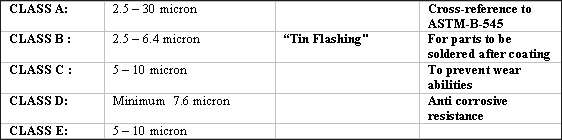
The possibilities of the tin according to ASTM B545 coating thickness are as follows:
| Class | Service condition | Thickness |
| A | Mild service | 2.5 micron minimum |
| B | Mild service | 5 micron minimum |
| C | Moderate service | 8 micron minimum |
| D | Severe service | 15-20 micron |
| E | Very severe service | 30 micron minimum |


